
Fire your spreadsheet. Know how your positions really perform.
For LPs who treat DeFi like a business. Automatic PnL, fees, impermanent loss and liquidation alerts across every position, protocol and chain you use.
DeFi Orbit gives serious LPs their evenings back
What individual LPs do with DeFi Orbit
Your whole book on one screen, calculated in real time
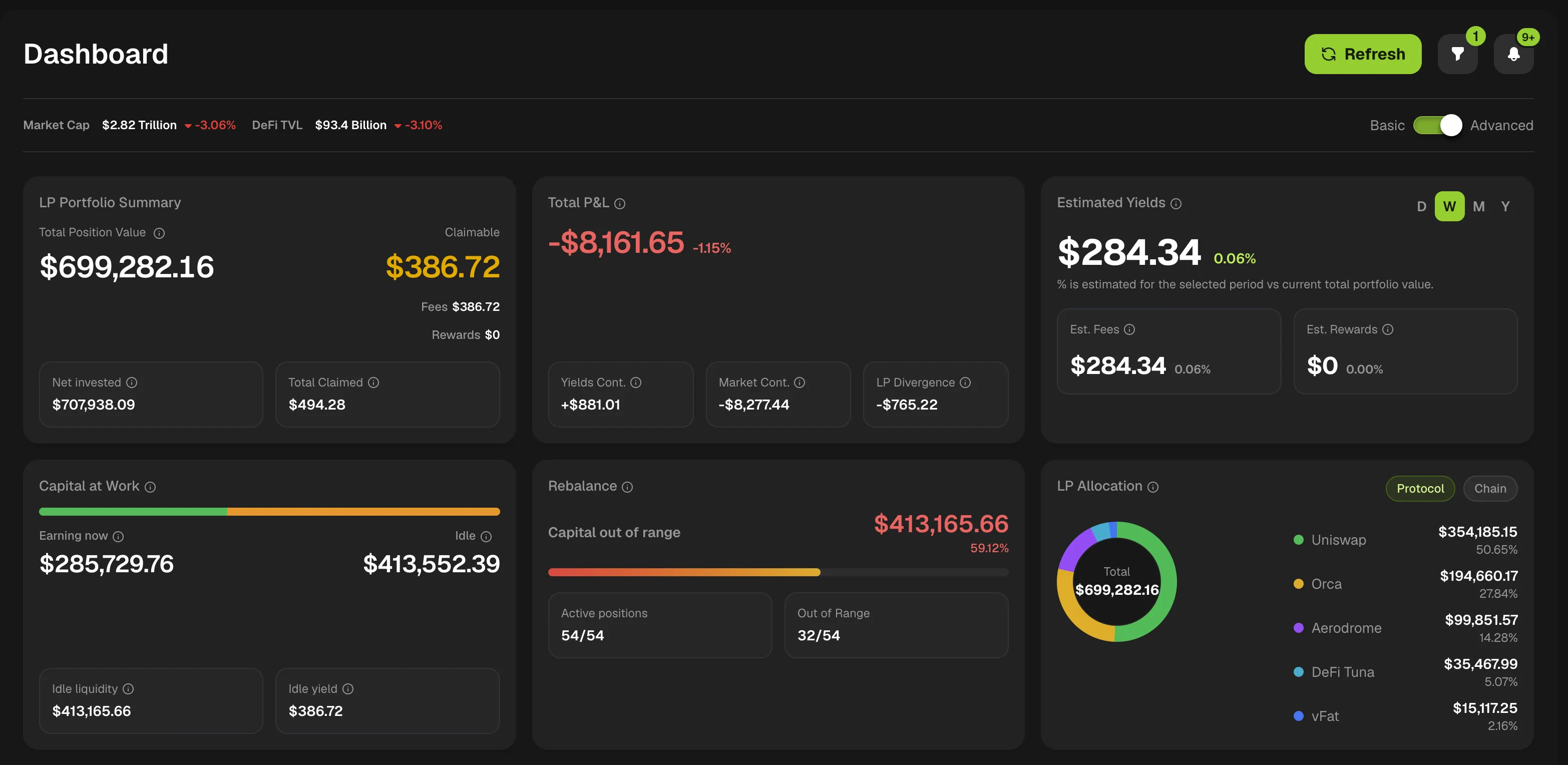
Add a wallet and stop updating cells
See whether each position beat simply holding
Get a Telegram message before a loan is liquidated
Every token and position across all your wallets
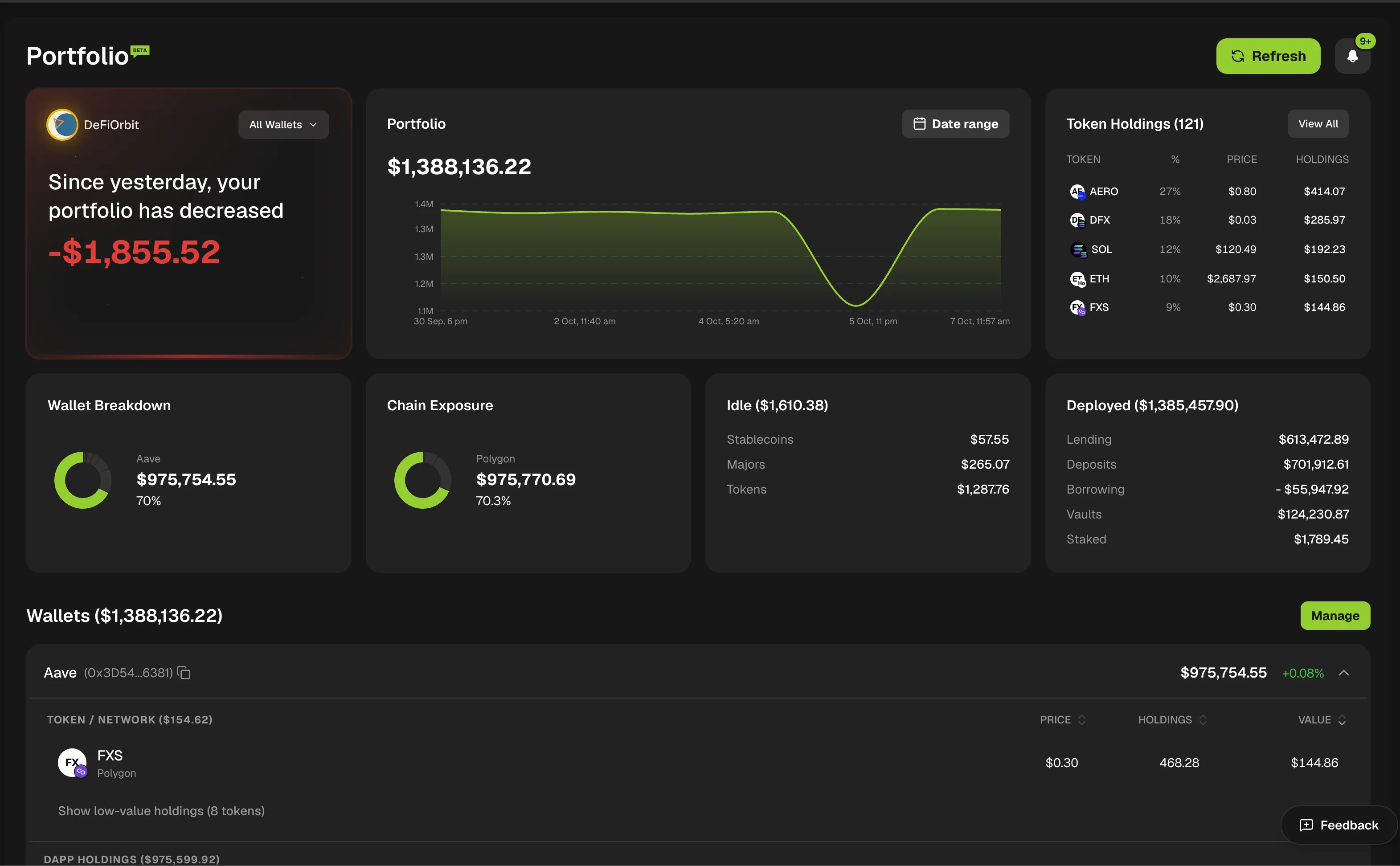
Three ways to use DeFi Orbit as an LP
One data layer behind all three. Most LPs start with the app.
Portfolio
Your whole book on one screen, with PnL, fees and alerts already calculated.
API Platform
Pull your own position data into a sheet, bot or script.
DeFi Orbit AI
Our MCP server gives your AI agents the same data, so your team can ask questions in plain language.
From our users
DeFi Orbit makes it easy and efficient to monitor my open positions and take action whenever needed. It has saved me a ton of time. Excellent LP tracking and traceability. It really helps me stay on top of my position and monitor their performance even with these market swings.
I used to rebuild my LP spreadsheet every Sunday. Now I open one screen and see fees, IL and P&L for every position.
The out-of-range alerts paid for the subscription in the first week. I rebalance when it matters, not when I remember.
Seeing yield split from market movement finally told me which pools were actually making money.
My Kamino and Aave loans sit next to my LP positions. One health factor view instead of three tabs.
It is read-only, so I connected a watch address and never had to sign anything.
Questions individual LPs ask
LPs who treat DeFi as an investment, with real capital in several positions across more than one protocol or chain. If you’re still updating a spreadsheet to know where you stand, this replaces it. It isn’t a trading tool and it won’t find pools for you; it tells you the truth about the ones you’re in.
No. When you create an account with your wallet you sign a short text message to prove you own it, and a message signature isn’t a transaction: it can’t move funds or approve anything. After that we only read public on-chain data for your addresses, and we never hold keys.
For liquidity: Uniswap V3, Aerodrome, Orca, vFat, DeFi Tuna and Revert. For lending: Aave, Morpho and Kamino. That covers concentrated liquidity on EVM chains and Solana plus the managers built on top of it, and the list grows as users ask.
Plans start at $57.50 a month billed yearly, or $69 billed monthly, with a 7-day free trial and no commitment. Most LPs are already paying for two or three trackers, communities and spreadsheets’ worth of time, so the question is usually what it replaces rather than what it adds.
Most trackers show token balances, and their position numbers break after a withdrawal or a rebalance. DeFi Orbit tracks every position through withdrawals and rebalances, so fees, PnL and impermanent loss stay right after you adjust it, and daily snapshots of your performance start from the day you sign up. Run it next to your current tool for a week and compare.
Yes. You’re notified when a position leaves its range or a lending position approaches its liquidation threshold, so you don’t have to check three times a day to feel safe. The health factor and range status are also on every position, every time you open the app.
It’s the APR you earned, not the one the pool advertised. We calculate it from the fees your position collected, against the capital in it, over the time it was open, and show impermanent loss next to it so you can see your true return against simply holding the tokens.